Freedom from Clinging: Kiss the Joy!

One of my first Dharma teachers was the appropriately named Dhammarati – he who delights in the law, the teachings of the Buddha. In 1984 I’d been attending the London (Triratna) Buddhist Centre for a few months following an initial 6-day residential retreat. I spotted a poster for a weekend event he was leading at the Centre and signed up. It was quite an intimate event with maybe 10 of us tucked away in a back study room in the large converted fire station in East London.

 I don’t remember much about the content of the weekend, but one gesture that Dhammarati used quite frequently has stayed with me for over 40 years. It is possible the theme had something to do with the Paramitas (Perfections), one of which is dana, or giving, because the gesture or mudra was of a clenched fist gently relaxing into an open hand. It is such a simple movement, but I find it striking that, rather than the teachings and discussions from those two days, this is what has stayed with me, not just as a memory or an image in the mind, but a visceral felt sense of this is what the spiritual life is about.

Open handed and open-hearted giving are said not to lead directly to wisdom itself but to be a crucial supporting factor. Sangharakshita has said that we should always be giving something; giving of our time or energy, giving materially, or giving of the Dharma. Giving of our confidence or fearlessness is another form of dana much needed in our world today. The Buddha said we should give freely, without expectation of reward or benefit in return. Training in dana as an attitude and an orientation point us towards the mind and heart that are, in those moments of giving, free from clinging.

In a recent interview for Tricycle Magazine, Joseph Goldstein talks about the defining issue that all Buddhist traditions have in common; they are tackling the deep-seated human tendency to cling and searching for the mind of ‘non-clinging.’ In those moments when we give, we go beyond our self-referential desires, including the desire to protect and insulate ourselves by shoring up physical and mental ‘stuff’ around us.  Dana softens the mind and helps make visible the deeper ways that the mind clings.

Clinging is that closed fist, and it hurts to cling. By clinging or grasping, we are trying to guard against losing what we are holding on to, and so we often feel tense and brittle. The heart-mind becomes tight and held in check, and this can translate to pain and tension in the body. This in turn creates uneasiness and an indefinable feeling that something isn’t quite right. Clinging is a deeply ingrained human habit, and mostly, we don’t know another way but to hang on. Our defensiveness is not protecting healthy boundaries but making sure we don’t lose what we consider ‘mine’ or whatever threatens ‘me.’

One of my favourite Dharma teachings is that of the Four Upadanas, four aspects of experience that we cling to. Firstly, the Buddha says, we cling to our sense experiences to try and create a feeling of security. Then there are two aspects relating to views; one to views in general including ideological and philosophical beliefs, and thirdly, views specifically about what we call ‘self.’ Finally, we cling to rituals and practices, creating an over-reliance on externals as a way to Enlightenment. These are a rich source of investigation – and we’ll be exploring them over New Year on a 5-day retreat (more info HERE).

Even though it creates suffering to keep our fist tightly closed, it is counter-productive to try to force it open. Practice is not about ignoring our own psychological defences but using a kindly, spacious, awareness with the intelligence of wisdom, to investigate how we cling and see for ourselves how it hurts. When we see this over time the natural response is to release clinging, to let go. In meditation, when we cultivate an awareness characterised by ease rather than control, and an open mind rather than a pre-determined agenda, we start to get a sense of what freedom from clinging feels like.

When we take awareness practice into our daily lives, we find many opportunities to recognize the tightening that happens when we hold onto views and opinions. At times we can access fruitful territory where we’re able to let go of being right, or of knowing what to do, or of needing to prove ourselves. We might notice the ‘planning’ mind looking to secure a future for itself a hundred times a day; that noticing, allows us to re-connect with the groundedness and groundlessness of present moment awareness. When we can stay with uncertainty and the disorientation that arises, rather than immediately jump to a limited security of thinking we know who we are and where we stand, we start to experience the rewards of non-clinging.

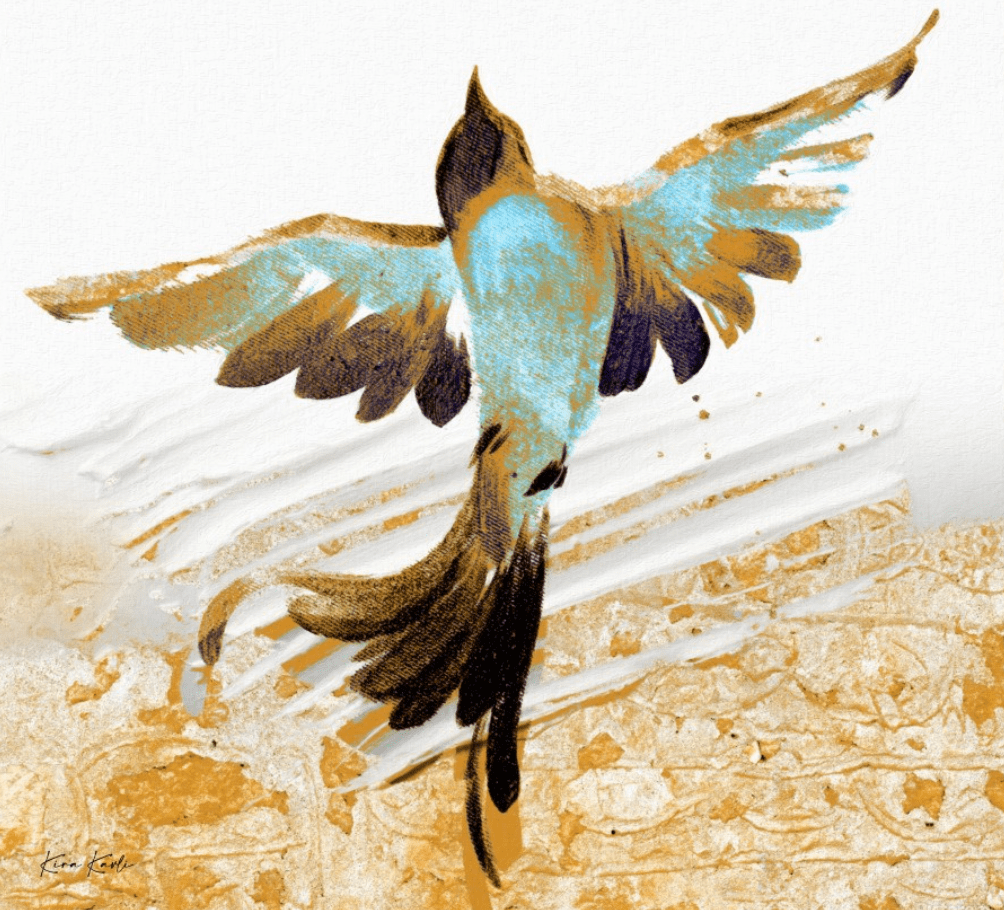
With an open hand and open mind, we can touch into the experience of those famous words by the poet and visionary, William Blake, we ‘kiss the joy as it flies.’ We stand within a flow of momentary experience and experience a kind of gleeful weightlessness. Freedom from Clinging is accomplished through standing, with awareness and wisdom, in the heart of the mind that clings.

Find out more about the retreat ‘Freedom from Clinging’ HERE

The Art & Practice of Bearing With

A few weeks ago, I was travelling back home by train. The journey was about 5 hours long and during the last of four different stretches the train started to fill up quickly. As people swarmed through the carriage looking for free seats, I was simultaneously trying to put upright a knocked over cup at my feet and pick up my day pack from the seat next to me with the intention to move it. A man stopped and indicated he’d like to sit in the seat. It was fairly obvious (to me) he thought I was reluctant to free up the seat and I told him in a slightly defensive tone that I was moving my bag.

I managed to get my bag on the floor between my knees and he sat down in the seat next to me. A simple and typical exchange on a crowded train you’d think. But I felt regret that I’d reacted, even though only slightly. It wasn’t really what I’d said, but how I’d said it. And I didn’t actually know if he’d been annoyed with me. Perhaps he was just a bit impatient. And anyway, what did it matter if he had assumed the worst – that I was one of those greedy passengers who want two seats while others have none! The atmosphere between us, these two strangers, felt a little sour. I tried to make eye contact, but he stared resolutely ahead. I wanted to say something, anything to lighten things up – but I could think of nothing.

I confessed this incident in a weekly meeting of practice friends, and after I’d described what had happened, I said that this particular area is a weak one for me. If I think I’ve been misunderstood, or my motives are misrepresented it stings. I don’t want to be seen in a way that’s stingier or meaner than I think I am. Or seen in a way that’s just wrong! I don’t like it. Maybe that’s fair enough, and this is probably true for many of us. The important thing is – what happens next? Does it end there? Or do we bite back? A third option which I think is a pretty common one is we manage not to say anything but we ruminate on what’s happened, and internally complain about the other persons attitude.

Sometimes, in certain situations, I’ll bite back. It’s a lose:lose response. It’s not nice for the other person and it’s uncomfortable for me. I usually feel bad that I’ve reacted. After I’d confessed this incident and the habitual nature of other moments like it, it got me thinking more about what happens during those times.

Life throws us moments where we’re misinterpreted or misunderstood. Someone picks up the wrong end of the stick about what we mean, and in a way that reflects badly on us. Or they do something that negatively impacts on us.

What do we do when that happens?

Why is it difficult at times to let it go? To let it roll off like water on a duck’s back?

One reason is that it is unpleasant, it hurts. It’s a moment of ‘dukkha’. When we feel judged or not seen for who we feel we are it is naturally unpleasant. When we’re mindful we’re able to ‘stay with’ what’s happening but our mindfulness is often not 360 degrees in the round. Because of our conditioning we all have sore spots, things that are more likely to trigger a reaction. For example, I find it painful and difficult to be ignored or forgotten about. I’m more likely to react in those circumstances even if mostly it stays as an internal reaction within my own mind.

Mindfulness has a lot in common with forbearance which Sangharakshita helpfully says is an aspect of patience. I think patience is a really beautiful quality with a lot of moral strength. Its opposite, impatience, is very self-absorbed, it’s all about what we want and wanting it now. In that moment we care very little about someone else’s reality. (Road rage is a dangerous example of this).

Forbearance is when we’re able to ‘stay with’ or even to ‘bear with’ the rush of uncomfortable sensations and feelings that can arise in the body and mind  when things aren’t the way we want them to be. It is possible (and desirable) to be mindful of the inner tensions that can arise when the impatient mind wants to act or speak in a way that’s an expression of reactivity. Whether we react internally or not, we can train the mind to be with difficult experiences without reacting externally to others. We practice bearing our own ‘dukkha’ without spraying it around to others.

The Buddha takes forbearance to extremes with an analogy in a teaching called the ‘Simile of the Saw’. He says even if bandits were to saw you from limb to limb train yourselves in this way “Let my mind be unaffected, I will not speak out in anger”. In another teaching the Buddha exhorts a particular Bhikkhu to ‘”Bear it Monk” when he is being treated badly by some villagers who he has previously wronged. This is the power of the unreactive mind; the power of not retaliating to small or large provocations.

The third aspect of my confession was to do with a lack of mindfulness working with wisdom. This happens when we take what someone else does or says personally. Something is being said or implied about ‘me’ that I’m not happy with and I need to protect myself. What rears up in the moment of reactivity is the desire to protect that all important sense of self.

The combination of mindfulness, forbearance and patience, along with clear recognition of ‘dukkha’ is a powerful way to progress in practice and to bring about wisdom. It can be helpful to take this area as a specific focus in practice. After all, it’s in relation to other people we most often experience feelings such as hurt, disappointment or anger. It’s easy to rationalize such incidents where we react as minor and unimportant but we can see how the mind feels when we do fully acknowledge our own faults even if in the greater scheme of things they are small. We don’t leave that sourness that I experienced on the train.

By working with difficult feelings we perfume the world more beautifully as well as our own minds.

Uncontrived Mindfulness & Other Power

On the face of it, the world of Pure Land Buddhism with its emphasis on devotion, on already being ‘saved’, and its sole practice being to chant the name of the Buddha Amitabha (Amida), would seem to have little in common with Mindfulness practice. Mindfulness practice is stripped back with a simple but powerful focus on what is actually happening within one’s own experience and looking to apprehend directly with wisdom ‘how things really are’. Myth, devotion and ritual are often not seen as playing a significant part.

Pure Land Buddhism is primarily about ‘other power’ – opening up to influences from beyond oneself such as the compassion of Amida Buddha, and mindfulness seen more on the side of ‘self-power’ where we need to cultivate or generate awareness.

I’ve been reading a book recently that has prompted some reflections around these areas of practice. The book is ‘The Promise of a Sacred World’ by Nagapriya (Windhorse Publications). Its focus is the 12th Century Japanese teacher Shinran who was influential in developments within the Pure Land tradition.

Initially I was enjoying the book but not finding a lot in common with my own practice of mindfulness, and even finding much of it somewhat alien to awareness practice. But increasingly Nagapriya, as he quoted and unpacked Shinran’s writings from 800 years ago, seemed to be associating ‘other power’ with ‘transformative awareness’. I found myself intrigued and inspired by, and also resonating with the book. I started seeing the connections between my own practice of mindfulness as a path to wisdom and other power.

Initially in awareness practice, even the very receptive kinds such as uncontrived mindfulness, we use ‘self-power’; there’s a cultivation of awareness in the present moment, we set an intention to be aware that sets the mind in a particular direction as opposed to another, and we regularly remind ourselves to be aware. All this is a subtle use of ‘self-power’. There is also self-power in the deliberate training perspective of ‘right view’ with the aim to clearly know what is happening in body and mind more objectively and impersonally. In both awareness and right view, we use self-power to train the mind to a point where awareness and wisdom become strong factors in the mind.

I sometimes use the metaphor of riding a bike to describe this process. Initially we need to push and then peddle, or we’ll fall right off the bike. Without gaining some speed we don’t have any stability or balance. But once we’re going, we peddle less and sometimes (especially going downhill) we don’t need to peddle at all. In fact, to do so is counterproductive and we get in our own way.

The same is true for mindfulness practice; at a certain point we can recognize that it’s not necessary to keep reminding ourselves. Awareness is already present and is working with wisdom under their own steam. We just need to notice that. There is now some momentum in practice. In Shinran’s words we’ve moved from “the false autonomy of ego-directed will’ to (as Nagapriya says) that which “permits a new kind of will to flourish.”

This new kind of will is not self-directed or self-referencing. The Right View perspective also grows stronger and more natural and works with awareness. In Sayadaw U Tejaniya’s words “awareness and wisdom do their own work”. They have become more natural to the mind and slipped the moorings of controlling self-power. They have become ‘other power’; more open to a world beyond that of ‘self’.

We need to be sensitive to this ‘new kind of will’ so that it flourishes. In these times it becomes easy to rest within the present moment. When we’re attentive to present moment experience at this point in practice there is a natural interest in how the mind is working. This interest is the beginnings of wisdom, and the awareness naturally wants to stay with watching and understanding the body/mind.

It turns out that what Shinran is describing is a pathway to the world of ‘transformative awareness’. That world is not separate from our limitations and faults but an ‘additional dimension’ that we can access at any time. The key is present moment awareness which, as we know, is always within our grasp. Whether we’re aware of our human frailties and foibles or knowing some new truth, both are held within awareness that transcends both.

When mindfulness becomes continuous the more attentive we are to the ‘luminous present’ the more access is gained to ‘other power’ as a ‘sacralised present moment’. The mythic aspect of the Pure Land is experienced as the preciousness of fully resting in presence. The language of myth and the sacred points to the mystery of awareness and the mysterious nature of experience. Awareness is precious without us needing to pin down why or how. It can’t be described or explained away; it has a touch of the ineffable. The promise of awareness is the promise of a sacred world where everything is touched by the quality of awareness and wisdom brought to it.

Relaxing the Conceptualizing Mind

A little story: about 25 years ago I was participating in a meditation workshop exploring thoughts. We were all led through a series of meditative exercises over the course of the morning. I felt very relaxed, present, and happy. The workshop leader then asked a question to which she made clear an answer was not expected but that asking the question could facilitate openness and curiosity to the experience in the moment. The question was ‘where do thoughts come from?’ – and even though she wasn’t looking for an answer – I had one! I didn’t offer it that day but the experience that arose with the question has stayed with me since then.

My ‘answer’ was from a slightly dreamy quality of mind that was simultaneously clear and distinct. ‘Thoughts come from the Alaya (‘store’) consciousness’. This thought took me by surprise but had a close resonance with the experience in the moment. It was clearly a conceptualization, and I was familiar with the idea from the Yogachara Buddhist tradition of the ‘alaya consciousness’ though it wasn’t one I used at all frequently.

The Alaya is said to hold mental impressions of all previous experiences, and these form the seeds of future experiences. It is a way of understanding patterns of behaviour and the momentum behind habits good and bad. It contains the idea that in the past we’ve repeated these habits many times, building up mental and emotional energy that makes them more likely to be repeated again in the present. They are the sum total of what makes us up.

So much for the idea of the alaya, back to my story – what was the actual experience like?

There was a feeling sense of experience as a mass of fragments of thoughts, impulses, and movements of mind. A kind of cosmic mental soup. I saw that some fragments rose to the surface of the mind and were identifiable or distinguishable – not as content but as experience. Others didn’t quite make it to the surface of full consciousness. There was a knowing that the more visible moments had more energy behind them. They were habitual drives and the strongest of them eventually would get expressed for good or ill. The literal seeing felt like the birth of a thought.

Something stayed with me from the short period this meditative experience lasted – some glimmering of an understanding of the nature of the mind and the mental objects within it.

I think about this experience infrequently and yet it came into consciousness during a recent meditation. It was the first time I’d sat for a few days as I’d been unwell with Covid. I still felt weak and breathless but wanted to get back to formal practice. My mind was all over the place, there were lots of thoughts but not enough energy to get involved with them or to be aware of individual arisings.

I found myself dropping in a practice instruction I often give at the end of a retreat when retreatants are about to leave the fairly low ‘conceptual load’ of retreat conditions and return to the ‘high conceptual load’ of daily life. The mental and emotional weight of making decisions large and small, various meetings, talking and using tech takes a lot of energy. The instruction is to find times to ‘rest back from the conceptualizing mind’ and prioritize the awareness mind by doing nothing.

This small thought really opened up my soggy covid brain into spaciousness and ease and a different relationship to mental activity. I was aware of thoughts and other mental movements but from a stance of lightness and brightness. There was a kind of relaxation and release from grasping onto detail and trying to make meaning from the illusive threads of experience. And it was possible to just stay there enjoying it.

When we sit without doing anything in particular there are times when doubts can arise about how we’re practicing, especially when experience isn’t pleasant. The voices of the conceptualizing mind can shout loudly driving us towards the more active ‘doing’ mode. ‘Shouldn’t I be doing something to change whatever is happening now?’. ‘I’ll never get anywhere with practice unless I use more effort’. The thinking mind has these thoughts and a thousand more. But are they true?

At these times we need to hold our nerve. Keep pointing true north. Is awareness present? Is right view/a dharma perspective present? Keep recognizing the conceptualizing thinking mind with its habits and its tendency to dominate other modes of being. Let the Awareness mode grow. Enjoy it. Appreciate it. You don’t know what it will grow into or what habits it will grow out of. It could bring in its wake a tide of ease or a transformative understanding. Keep going.